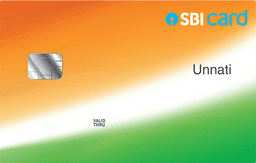
SBI Card Unnati Review 2026: Free for 4 Years, Secured Against an FD, ₹500 Cashback & FAQs
SBI Card Unnati is free for its first four years and is issued against an SBI fixed deposit of ₹25,000 or more. It pays a flat 0.25% plus ₹500 cashback at ₹50,000 annual spend. Who it is for, how the FD works, fees and FAQs.
SBI Card Unnati is not a rewards card, and judging it as one misses the point entirely. It is a secured credit card issued against a lien on your SBI fixed deposit, and it exists to do one job: build a credit history for someone who cannot get an unsecured card. It is free for its first four years, pays a flat 0.25%, and returns ₹500 cashback at ₹50,000 of annual spend.
If you already qualify for an unsecured card, almost anything else in SBI's range will serve you better. If you do not, this is one of the cheapest on-ramps to a credit score in India.
SBI Card Unnati Quick Overview
| **Card type** | Secured entry card, issued against a fixed deposit |
|---|---|
| **Best for** | First-time borrowers, thin-file applicants, anyone rebuilding credit |
| **Annual fee** | **₹0 for the first four years**; ₹499 + GST from year five |
| **Security** | Lien on an SBI fixed deposit of **₹25,000 or more** |
| **Network** | RuPay |
| **Reward rate** | **0.25% flat** — 1 Reward Point per ₹100, no accelerated category |
| **Reward type** | Reward Points, worth ₹0.25 each (4 RP = ₹1) |
| **Milestone** | **₹500 cashback** at ₹50,000 of annual spend |
| **Welcome benefit** | None |
| **Lounge access** | None |
Eligibility: The Fixed Deposit Is the Qualification
This is the defining feature. The card is issued against a lien on an SBI fixed deposit of ₹25,000 or more — the deposit is not liquidated, it is simply pledged. You continue to earn FD interest on it.
Because the deposit secures the card, income is not the qualifying test. SBI publishes no minimum income for Unnati, which is precisely the point: it is available to applicants an income-based assessment would reject — students, new earners, the self-employed with irregular documentation, and anyone rebuilding after a poor credit episode.
Indian residency and a valid PAN are required. Add-on cards are free.
What this means in practice: your credit limit is set against the deposit, you use the card normally, you pay the bill normally, and the repayment history is reported to the credit bureaus like any other card. After a year or two of clean conduct, an unsecured card becomes obtainable.
"Free for Four Years" — What That Actually Means
SBI's headline is "Card is free for first 4 years." The underlying annual fee is ₹499, waived for four years.
From year five, the ₹499 applies — and SBI publishes no spend-based reversal condition for it. There is no "spend ₹X and the fee is waived" on this card, unlike SimplySAVE (₹1 lakh) or CASHBACK (₹2 lakh). So plan on four free years, then a decision: pay ₹499 a year, or by then move to a card that suits you better.
Four years is, not coincidentally, roughly how long a consistent repayment record takes to establish a solid credit profile. The card is built to be outgrown.
Reward Structure: Flat, and Deliberately Simple
| Spend | Points | Effective rate |
|---|---|---|
| Everything eligible | 1 RP per ₹100 | **0.25%** |
| Fuel | Nil | **0%** |
| Cash advance, balance transfer, Flexipay | Nil | **0%** |
There is no accelerated category at all. No grocery bonus, no dining bonus, no online bonus. Reward Points are worth ₹0.25 each, so the card returns a flat quarter of a per cent on everything.
That is low — but it is also not what you are here for. A secured card that pays anything is doing more than the alternative, which for many applicants is no card at all.
SBI names four exclusions on this card explicitly: cash advances, balance transfers, Flexipay and fuel.
The ₹500 Cashback Milestone
₹500 cashback at ₹50,000 of annual spend.
Run the numbers: ₹500 on ₹50,000 is 1% on the threshold — four times the base reward rate. At roughly ₹4,200 a month of spending, it is comfortably reachable for anyone using the card as their main card.
Combined with the 0.25% base rate, a cardholder spending exactly ₹50,000 a year takes ₹125 in points plus ₹500 in cashback — ₹625, or 1.25% — on a card that costs nothing.
This is the card's only recurring benefit. There is no welcome bonus, no renewal benefit, no lounge access and no insurance.
Worked Example
Illustrative, at ₹6,000 a month:
| Annual spend | ₹72,000 |
|---|---|
| Reward Points (0.25%) | 720 RP = **₹180** |
| Milestone cashback (₹50,000 cleared) | **₹500** |
| **Total return** | **₹680 — 0.94%** |
| Annual fee (years 1–4) | **₹0** |
| **Net benefit** | **₹680** |
From year five, the same profile returns ₹680 against a ₹499 fee — a net ₹181. Marginal, and the point at which to review.
Note how much of the return is the milestone. Below ₹50,000 of annual spend, the card returns only 0.25%, so on ₹30,000 of spending you take ₹75 for the year. The milestone is the thing to aim at.
Where You Won't Earn
| Excluded | Note |
|---|---|
| **Fuel** | MCC 5172, 5541, 5542, 5983 |
| **Cash advances** | 2.5% fee, minimum ₹500, interest from day one |
| **Balance transfers** | — |
| **Flexipay** | — |
The fuel surcharge waiver is the whole fuel benefit: 1% reversed on transactions between ₹500 and ₹3,000, capped at ₹100 per statement cycle.
SBI's range-wide transaction fees apply here too: ₹199 per rent payment, 1% on wallet loads above ₹1,000, 1% on utility payments once the cycle total passes ₹50,000, and 1% on education payments through third-party apps.
Fees and Charges
| Charge | Amount |
|---|---|
| Annual fee, years 1–4 | **₹0** |
| Annual fee, year 5 onward | ₹499 + GST — **no spend-based reversal published** |
| Add-on card fee | Nil |
| Finance charge | 3.75% per month — **45% per annum** |
| Interest-free period | 20 to 50 days; none if any part of last month's bill is unpaid |
| Forex markup | 3.5% |
| Cash advance fee | 2.5%, minimum ₹500 |
| Fuel surcharge waiver | 1% on ₹500–₹3,000, max ₹100 per cycle |
| Late payment | ₹100 to ₹1,300 by balance |
| Overlimit | 2.5%, minimum ₹600 |
| Reward redemption fee | ₹99 on physical products, statement credit and physically-sent vouchers |
| GST | 18% on all of the above |
The 45% finance charge is the number that matters most on this card, and it deserves emphasis precisely because Unnati's holders are often new to credit. Revolving a ₹20,000 balance for a year costs roughly ₹9,000 in interest — more than fourteen years of this card's rewards. A secured card is a credit-building tool only if the bill is paid in full every month. Carry a balance and it becomes an expensive loan that also damages the score you took the card out to build.
Note too that the ₹99 reward redemption fee exceeds a year's earnings for many Unnati holders. Accumulate points across several years before redeeming, or redeem against the outstanding in a single larger block.
How to Use Unnati Well
- Put routine, predictable spending on it — groceries, phone bills, transport — so the ₹50,000 threshold is cleared without effort.
- Set up auto-debit for the full statement amount, not the minimum. This is the single most important habit.
- Keep utilisation moderate. Spending close to your limit every month reads poorly to bureaus even when you pay in full.
- Review at year four. By then you should qualify for an unsecured card. The ₹499 arriving in year five is a natural prompt.
- Don't close it carelessly. A long-held account helps your credit age. If you upgrade, consider keeping Unnati open if the fee is tolerable.
Is SBI Card Unnati Worth It?
Yes, if you cannot get an unsecured card. Four free years, a ₹25,000 FD that keeps earning interest, and a bureau-reported repayment record is a genuinely good deal. The 0.25% is beside the point.
Yes, as a first card for a student or new earner. No income documentation, no fee, and a ₹500 annual cashback that is easy to reach.
No, if you already qualify for an unsecured card. SimplySAVE at ₹499 pays 1.67% on four categories with the fee reversed at ₹1 lakh. CASHBACK at ₹999 pays 5% online. Both are vastly better earners, and neither ties up a deposit.
No, if you are shopping on rewards. A flat 0.25% with no accelerated category is the weakest earn structure in SBI's range, by design.
Frequently Asked Questions
Is SBI Card Unnati really free? For the first four years, yes — SBI waives the ₹499 annual fee over that period. From year five the ₹499 applies, and no spend-based reversal condition is published for it.
Do I need a fixed deposit to get it? Yes. The card is secured against a lien on an SBI fixed deposit of ₹25,000 or more. The deposit is pledged, not liquidated, and continues to earn interest.
Is there an income requirement? SBI publishes none. The fixed deposit, not income, is the qualifying test — which is what makes the card accessible to students, new earners and anyone with a thin or damaged credit file.
What is the reward rate? A flat 1 Reward Point per ₹100 on all eligible spends — 0.25% at 4 points to the rupee. There is no accelerated category on this card.
What is the ₹500 cashback? A milestone benefit: spend ₹50,000 in a year and you receive ₹500 cashback. On the threshold that is a 1% return, four times the base rate, and it is the card's only recurring benefit.
Does Unnati help build a credit score? Yes. It is reported to the credit bureaus like any other credit card, so consistent full repayment builds a record. Revolving a balance at 45% per annum will damage both your finances and your score, so pay in full every month.
Does it come with lounge access or insurance? No. Unnati has no lounge programme, no insurance, no welcome bonus and no accelerated categories.
What happens after four years? The ₹499 annual fee begins. By that point a clean repayment history should qualify you for an unsecured card — the fee is a natural prompt to review whether to upgrade.
Cards Mentioned in This Article